



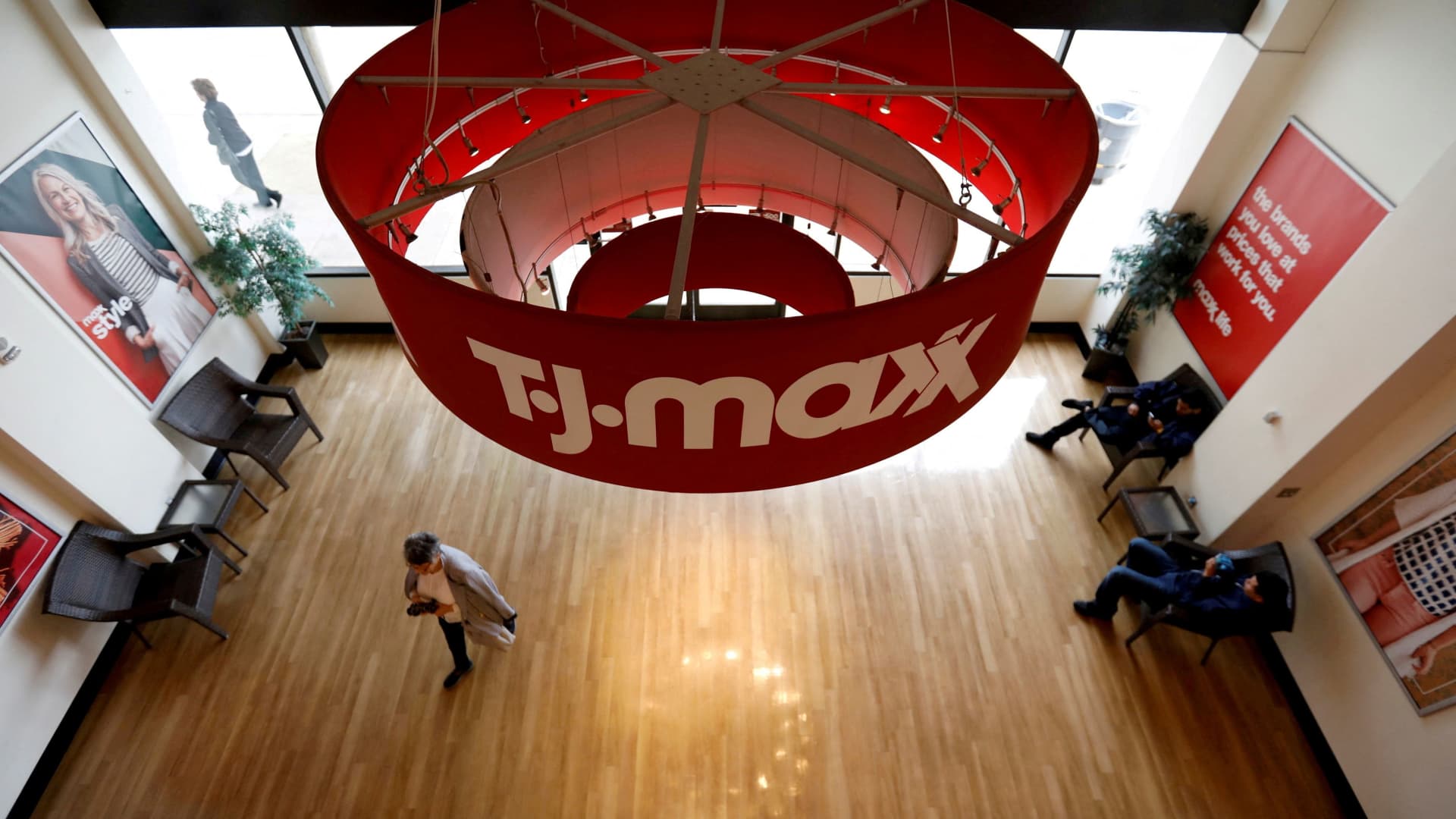
A T.J. Maxx store in Pasadena, California.
Mario Anzuoni | Reuters
Off-price retailers like TJX Corporations and Ross are still posting sales gains and taking market share from rivals, nevertheless it’s not simply because consumers are under pressure and attempting to find value.
Persistent inflation and rising prices for essentials like food and gas have pushed shoppers to trade malls like Macy’s and Kohl’s for discounters like TJ Maxx and Ross. But they’ve also develop into cooler places to buy, particularly amongst younger consumers, and their assortments have gotten higher because brands increasingly view them as a growth channel as malls proceed to shrink and lose share.
“They’ve trusted brands at a less expensive price. They’re more on-trend, they’re designer-led, they lean into categories that the client is far more excited about,” said Jessica Ramirez, a senior research analyst with Jane Hali & Associates. “When it comes to categories that perhaps should not resonating as well, they pull back from them and so they have that ability due to their … strategy. A department store doesn’t have that.”
TJX and Ross each reported fiscal first quarter earnings last week that got here in higher than Wall Street expected, whilst each firms lapped outsize growth from the prior-year period.
TJX, which runs brands like TJ Maxx, Marshalls and Homegoods, saw sales grow 6% to $12.48 billion, in comparison with estimates of $12.46 billion, in accordance with LSEG. That is on top of the three% sales increase the retailer saw within the prior-year period.
Ross, which runs Ross Dress for Less and dd’s Discounts, posted an 8% jump in sales, bringing revenue to $4.86 billion, in comparison with estimates of $4.83 billion, in accordance with LSEG. That is on top of the three.7% gain it posted within the prior-year period.
Each firms have grown substantially since 2019 and posted banner results throughout 2023.
The particularly strong performance last 12 months led some Wall Street analysts to wonder in the event that they’d have the ability to proceed to grow sales up against tougher comparisons. They’ve managed to just do that – and the party is not expected to finish anytime soon.
Consumers are still prioritizing value
As consumers contend with persistent inflation, rising debt and stubbornly high rates of interest, they have been more selective about where they’re spending their precious discretionary dollars. Value has been top of mind.
“We expect that the off-price sector remains to be healthy and we expect that results this quarter, each for [TJX] and Ross, are showing consistent traffic-driven comp increases, which indicate that the buyer remains to be on the lookout for value and the buyer still finds off price’s business model of branded goods at value prices as a sexy buying opportunity,” Goldman Sachs analyst Brooke Roach told CNBC. She said she expects each firms to proceed to grow this 12 months, on top of the sales increases they saw last 12 months.
The low-to-middle income consumer has been feeling the burn a bit more acutely than their higher income counterparts, but even shoppers with deeper wallets have been turning to discounters for not only necessities, but in addition discretionary items.
During a call with analysts on Wednesday morning, TJX’s finance chief John Klinger said the corporate is seeing comparable sales increase in areas where the typical household income is each above and below $100,000 – a theme the retailer has seen consistently during the last 12 months.
Ross’s Chief Operating Officer Michael Hartshorn said the corporate can also be continuing to draw a broad array of consumers across a wide range of income levels.
Even discounters like Walmart and Dollar Tree are making gains with high-income consumers. On May 16, Walmart beat quarterly earnings and revenue expectations partially due to the work it’s done to win over more high-income shoppers. Earlier this 12 months, Dollar Tree said its fastest growing demographic makes greater than $125,000 annually.
‘We have develop into a cooler place to buy’
The buyer’s flight to value has undoubtedly helped TJX and Ross boost sales during the last 12 months, but each firms have steadily grown over time and are likely to do well in any economic cycle.
“That is because they’re providing consistent value to the buyer – and that is branded consistent value to the buyer at a reduction price,” said Roach. “So in case you look, historically, in times of economic strength, these businesses were still market share gainers. We see no reason why that ought to change.”
Simeon Siegel, a retail analyst for BMO Capital Markets, said off-price has managed to grow steadily partially because consumers are beginning to see the stores in a special light.
“We’d like to also recognize that [TJX] convinced shoppers that they were fashionistas, not penny pinchers, and I believe that was a really powerful and possibly healthy shift in mindset,” said Siegel. “They took something that was embarrassing and turned it right into a badge of honor. They took a transaction, turned it into an experience. It was not find something and conceal it and wear it as in case you bought it full price. As an alternative it became acceptable and exciting.”
Siegel said the expansion in off-price says just as much about consumer psyche and health because it does about this transformation in perception.
During TJX’s earnings call, CEO Ernie Herrman said the corporate has “develop into a cooler place to buy” and has made major inroads with the young Gen Z customer.
“We’re the one retailer at once that I see that’s in a position to take brands and fashion and quality and put all of that together on this treasure hunt format,” said Herrman.
The dynamic is a bit different at Ross, which has more exposure to the lower- and middle-income consumer than TJX does and competes more on price, said Siegel. Throughout the first fiscal quarter, TJX’s growth was “entirely driven by customer transactions,” which suggests more people were shopping there. Ross cited higher average selling prices, offset by fewer units per transaction.
Brands’ best kept secret
Up to now, the off-price sector was seen as a spot for brands to dump last season’s inventory, or items that did not pass quality control tests. Lately, the chains have develop into a destination for firms trying to grow wholesale revenue, even when they are not broadcasting it.
“Corporations will proceed to discuss [putting fewer of] their products within the off-price channel at the identical time that they might thoroughly be sending orders straight to them,” said Siegel.
The aisles at off-price retailers aren’t crammed with private label junk, but as a substitute, the sorts of household names that customers know and love like Nike, Adidas, Michael Kors and Ralph Lauren.
For some time, a lot of those big names tried to chop the variety of items they were selling within the off-price channel — and thru wholesalers overall — so that they could grow sales in their very own web sites and stores. But many brands are beginning to retreat from that strategy and are increasingly seeing the worth that wholesale partners of all varieties can offer.
“When you’re a big brand, you are watching malls surrender share and also you realize that [direct-to-consumer] is not any longer the Holy Grail that you just thought it once was, there are shrinking places to sell a number of units,” said Siegel. “And in case you’re a big brand, you want to sell a number of units.”
As brands have seen consumers change how they view off-price stores, they’re more willing to sell to chains like TJX and Ross, especially because they’ll achieve this “invisibly,” said Siegel.
Department shops like Macy’s, for instance, have an enormous online presence and repeatedly blast out promotions on name brand items, which might have a dilutive effect on brand equity. As compared, the majority of TJX’s and Ross’s business is finished in stores, so the markdowns aren’t as obvious or visible.
“As off-price becomes a much bigger a part of the U.S. apparel ecosystem, we have seen that off-price has develop into more vital to brands across the apparel and accessories sector,” said Roach. “[TJX] specifically has talked about strengthening relationships and the power to be higher partners with those brands, and that they’re a sexy partner because they’re growing and people brands can grow with them.”
The CEOs of each TJX and Ross talked about their strong vendor relationships and the way they’re having access to higher products at scale.
“At a high level, the merchants improved the worth offerings that that they had, whether it’s different assortments, broader assortments, higher quality, higher products. So I believe we have taken our first step forward there,” said Ross CEO Barbara Rentler. “We feel like there’s room for us to enhance and if we proceed to enhance, even this low-income customer, if we will satisfy her, we should always do fantastic.”
TJX’s CEO put it a bit more bluntly.
“An increasing number of vendors, they’ve much more reasons to need to sell us versus others because their goods in our store now hang with the perfect,” said Herrman. “They’re coping with a buying team that is very straightforward and an organization that has money and will likely be paying.”