



David Paul Morris/Bloomberg via Getty Images
Inflation popped in 2022 to a level unseen in 4 many years.
But prices ballooned more rapidly for certain items than others, largely concentrated amongst food, fuel and airfare.
A few of those swings were attributable to outlying aspects that prolonged beyond broad inflationary pressures corresponding to snarled supply chains, labor shortages, burgeoning consumer demand and Russia’s invasion of Ukraine.
Here’s a have a look at the ten items with the biggest price gains, as measured by the annual inflation rate in December. Percentages are from the most recent consumer price index data, issued Thursday.
Food at college: 305.2%
The worth of a meal at elementary and secondary schools spiked probably the most in 2022, by a whopping 305%.
Within the early days of the pandemic, the federal government enacted a program offering free meals to all public-school students, no matter family income. That program — which expanded an existing one for lower-income families — ended Sept. 30.
Overall food prices have been pressured on many fronts, too, funneling into school meals.
For instance, respective annual inflation rates for groceries and meals away from home hit 13.5% and eight% in August — their highest since 1971 and 1981, respectively.
Russia’s invasion of Ukraine created an energy supply shock, contributing to higher transport costs to deliver food from farm to table. That combined with other aspects corresponding to higher labor costs to underpin fast-rising prices throughout the food complex.
“Food inflation has been nuts,” said Tim Mahedy, senior economist at KPMG. “We hadn’t seen [these levels] consistently really in many years.”
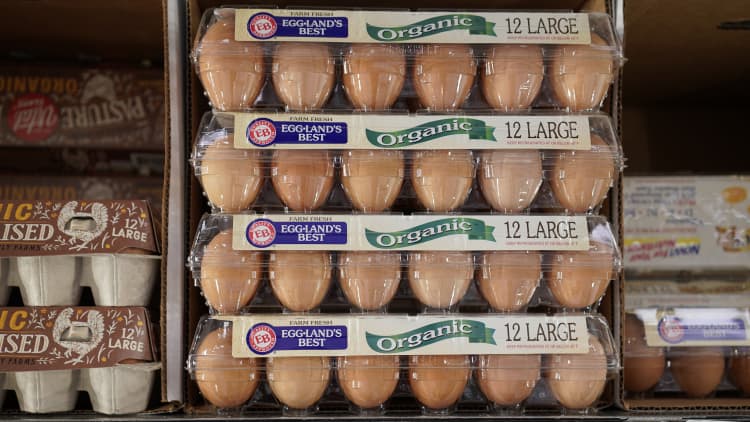
Eggs: 59.9%
Margarine: 43.8%
Global shocks in major markets for vegetable oil — a key ingredient in margarine — drove margarine prices up by 43.8% in 2022.
Prices for commodities corresponding to soybean, palm, sunflower and rapeseed (also often known as canola) oil are inclined to move together — meaning a supply disruption for one tends to affect the group, economists said.
For instance, Ukraine is the No. 1 global producer and exporter of sunflower oil. The war there squeezed supplies.
Further, Indonesia accounts for over half the world’s palm oil; the country imposed a short lived ban on exports last 12 months and other restrictions, corresponding to an export levy. Severe drought in Canada — the world’s largest canola-oil exporter — throttled supply. And soybean yields in Brazil fell attributable to weather conditions.
Fuel oil (41.5%) and motor fuels (32.3%)
When crude-oil prices spiked in the primary half of the 12 months, so did those of its refined byproducts.
Russia’s full-scale invasion of Ukraine began Feb. 24. By March 8, a barrel of crude oil had hit its highest inflation-adjusted price since 2014, amid concerns concerning the war’s impact on supply, according to the U.S. Energy Information Administration.
“It caused anything energy-related to leap,” said Mark Zandi, chief economist at Moody’s Analytics.
Oil prices retreated within the second half of the 12 months, though, as fears mounted of a possible recession and an accompanying weakness in oil demand.
Gasoline prices fell, too, ending the 12 months down 1.5%. But prices for other oil products have not declined as steeply. Fuel oil and other motor fuels corresponding to diesel ended the 12 months up 41.5% and 32.3%, respectively.
Butter (31.4%) and other dairy (21.4%)
A decline in global milk output — amongst major producers corresponding to Australia, the European Union and Latest Zealand — squeezed prices for butter and other dairy products.
Monthly milk production amongst major suppliers fell every month from September 2021 to June 2022, according to the U.S. Department of Agriculture.
“They’ve all been pretty pressured in terms of accessible milk supply,” Amy Smith, vp at Advanced Economic Solutions, a consulting firm specializing in food economics, said of the dairy complex.
Stephen Gibson / Eyeem | Eyeem | Getty Images
Output was stable within the U.S., which raised exports to plug the gap. U.S. dairy export volumes were up 5% in 2022 through October, relative to the identical period in 2021, in accordance with USDA data. Butter exports grew by 43% over that point — resulting in a lower butter supply at home, economists said,
Further, Russia and Ukraine are major suppliers of wheat. The war impacted grain supplies, raising the worth of animal feed and costs for farmers, economists said.
Butter prices ended 2022 up 31.4%. Other dairy products (excluding milk, cheese and ice cream) were up 21.4%.
Airline fares: 28.5%
Airfare was up almost 29% in 2022 as consumers with ample money available unleashed just a few years of pent-up wanderlust.
That demand ran headlong into airline industry shortages for pilots, lots of whom were laid off or retired early within the pandemic. Jet-fuel costs surged and airlines flew fewer routes. These aspects crimped the provision of airline seats, economists said.
“People have shifted their spending away from goods to travel, restaurants and ball games,” Zandi said. “Airplanes have been packed.”
Nonetheless, average fares began retreating in October, November and December.
Lettuce: 24.9%
An insect-borne virus “raging” through the Salinas Valley growing region in California led lettuce prices to surge in 2022, said Mahedy of KPMG.
The region, which has been known as “America’s salad bowl,” accounts for about half of U.S. lettuce production, according to Aaron Smith, a professor of agricultural economics on the University of California, Davis.
Russia can be the world’s top fertilizer exporter. Prices for fertilizer — amongst farmers’ biggest costs — hit all-time highs in spring 2022 after Russia invaded Ukraine, according to the Federal Reserve Bank of St. Louis.
The worth of vegetables and fruits were “significantly affected” by that run-up in prices, Zandi said.
Flour: 23.4%
Ukraine and Russia are major wheat exporters. The nations accounted for 28% of all exports globally in 2021, according to the USDA.
War led to uncertainty about export volumes and impact on the spring planting season, causing prices to spike. The worth dynamic impacted flour, which is milled from wheat, Smith said.