


An attendee wears a “Will Work for NFTs” shirt throughout the CoinDesk 2022 Consensus Festival in Austin, Texas, US, on Thursday, June 9, 2022. The festival showcases all sides of the blockchain, crypto, NFT, and Web 3 ecosystems, and their wide-reaching effect on commerce, culture, and communities.
Jordan Vonderhaar | Bloomberg | Getty Images
A 12 months ago this week, investors were describing bitcoin as the longer term of cash and ethereum because the world’s most vital developer tool. Non-fungible tokens were exploding, Coinbase was trading at a record and the NBA’s Miami Heat was just into its first full season within the newly renamed FTX Arena.
Because it seems, that was peak crypto.
Within the 12 months since bitcoin topped out at over $68,000, the 2 largest digital currencies have lost three-quarters of their value, collapsing alongside the riskiest tech stocks. The industry, once valued at roughly $3 trillion, now sits at around $900 billion.
Somewhat than acting as a hedge against inflation, which is near a 40-year high, bitcoin has proven to be one other speculative asset that bubbles up when the evangelists are behind it and plunges when enthusiasm melts and investors get scared.
And the $135 million that FTX spent last 12 months for a 19-year take care of the Heat? The crypto exchange with the naming rights is poised to land within the history books alongside one other brand that when had its logo on a sports facility: Enron.
In a blink this week, FTX sank from a $32 billion valuation all of the technique to bankruptcy as liquidity dried up, customers demanded withdrawals and rival exchange Binance ripped up its nonbinding agreement to purchase the corporate. FTX founder Sam Bankman-Fried admitted on Thursday that he “f—ed up.” On Friday, he stepped down as CEO.
“Looking back now, the joy and costs of assets were clearly getting ahead of themselves and trading far above any fundamental value,” said Katie Talati, director of research at Arca, an investment firm focused on digital assets. “Because the downturn was so fast and violent, many have proclaimed that digital assets are dead.”
Whether crypto is ceaselessly doomed or will eventually rebound, as Talati expects, the 2022 bloodbath exposed the industry’s many flaws and served as a reminder to investors and the general public why financial regulation exists. Bankruptcies have come fast and furious since midyear, leaving clients with crypto accounts unable to access their funds, and in some cases scrapping to retrieve pennies on the dollar.
If that is indeed the longer term of finance, it’s looking fairly bleak.
Crypto was presupposed to bring transparency. Transactions on the blockchain could all be tracked. We didn’t need centralized institutions — banks — because we had digital ledgers to function the only source of truth.
That narrative is gone.
“Speaking for the bitcoiners, we feel like we’re trapped in a dysfunctional relationship with crypto and we would like out,” said Michael Saylor, executive chairman of MicroStrategy, a technology company that owns 130,000 bitcoins. “The industry must grow up and the regulators are coming into this space. The long run of the industry is registered digital assets traded on regulated exchanges, where everyone has the investor protections they need.”
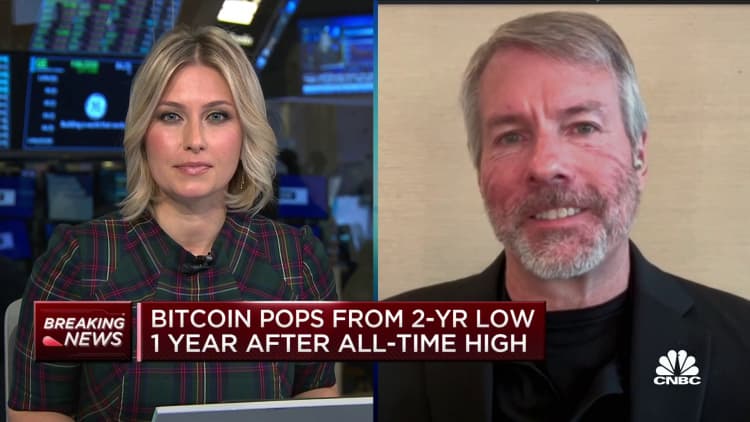
Saylor was speaking on CNBC’s “Squawk on the Street” as FTX’s demise roiled the crypto market. Bitcoin sank to a two-year low this week, before bouncing back on Thursday. Ethereum also tanked, and solana, one other popular coin utilized by developers and touted by Bankman-Fried, fell by greater than half.
Equities tied to crypto suffered, too. Crypto exchange Coinbase tumbled 20% over two days, while Robinhood, the trading app that counts Bankman-Fried as one in all its biggest investors, fell by 30% throughout the same period.
There was already loads of pain to go around. Last week, Coinbase reported a revenue plunge of greater than 50% within the third quarter from a 12 months earlier, and a lack of $545 million. In June, the crypto exchange slashed 18% of its workforce.
“We’re actively updating and evaluating our scenario plans and ready to cut back operating expenses further if market conditions worsen,” Alesia Haas, Coinbase’s finance chief, said on the Nov. 3 earnings call.
The way it began
The downdraft began in late 2021. That is when inflation rates began to spike and sparked concern that the Federal Reserve would begin mountaineering borrowing costs when the calendar turned. Bitcoin tumbled 19% in December, as investors rotated into assets deemed safer in a tumultuous economy.
The sell-off continued in January, with bitcoin falling 17% and ethereum plummeting 26%. David Marcus, former head of crypto at Facebook parent Meta, used a phrase that might soon enter the lexicon.
“It’s during crypto winters that the most effective entrepreneurs construct the higher firms,” Marcus wrote in a Jan. 24 tweet. “That is the time again to give attention to solving real problems vs. pumping tokens.”
The crypto winter didn’t actually hit for a couple of months. The markets even briefly stabilized. Then, in May, stablecoins became officially unstable.
A stablecoin is a style of digital currency designed to keep up a 1-to-1 peg with the U.S. dollar, acting as a type of checking account for the crypto economy and offering a sound store of value, versus the volatility experienced in bitcoin and other digital currencies.
When TerraUSD, or UST, and its sister token called luna dove below the $1 mark, a distinct sort of panic set in. The peg had been broken. Confidence evaporated. Greater than $40 billion in wealth was worn out in luna’s collapse. Suddenly it was as if nothing in crypto was secure.
The leading crypto currencies cratered, with bitcoin dropping 16% in a single week, putting it down by greater than half from its peak six months earlier. On the macro front, inflation had shown no sign of easing, and the central bank remained committed to raising rates as much as could be required to slow the rise in consumer prices.
In June, the underside fell out.
Lending platform Celsius paused withdrawals due to “extreme market conditions.” Binance also halted withdrawals, while crypto lender BlockFi slashed 20% of its workforce after greater than quintupling for the reason that end of 2020.
Distinguished crypto hedge fund Three Arrows Capital, or 3AC, defaulted on a loan price greater than $670 million, and FTX signed a deal giving it the choice to purchase BlockFi at a fraction of the corporate’s last private valuation.
Bitcoin had its worst month on record in June, losing roughly 38% of its value. Ether plummeted by greater than 40%.
Then got here the bankruptcies.
Singapore-based 3AC filed for bankruptcy protection in July, just months after disclosing that it had $10 billion in assets. The firm’s dangerous strategy involved borrowing money from across the industry after which turning around and investing that capital in other, often nascent, crypto projects.
After 3AC fell, crypto brokerage Voyager Digital wasn’t far behind. That is because 3AC’s massive default was on a loan from Voyager.
“We strongly imagine in the longer term of the industry however the prolonged volatility within the crypto markets, and the default of Three Arrows Capital, require us to take this decisive motion,” Voyager CEO Stephen Ehrlich said on the time.
Next was Celsius, which filed for Chapter 11 protection in mid-July. The corporate had been paying customers interest of as much as 17% to store their crypto on the platform. It will lend those assets to counterparties willing to pay sky-high rates. The structure got here crashing down as liquidity dried up.
Meanwhile, Bankman-Fried was making himself out to be an industry savior. The 30-year-old living within the Bahamas was poised to select up the carnage and consolidate the industry, claiming FTX was in higher position than its peers since it stashed away money, kept overhead low and avoided lending. With a net price that on paper had swelled to $17 billion, he personally bought a 7.6% stake in Robinhood.
SBF, as he’s known, was dubbed by some as “the JPMorgan of crypto.” He told CNBC’s Kate Rooney in September that the corporate had within the neighborhood of $1 billion to spend on bailouts if the proper opportunities emerged to maintain key players afloat.
“It isn’t going to be good for anyone long run if we’ve real pain, if we’ve real blowouts, and it is not fair to customers and it is not going to be good for regulation. It isn’t going to be good for anything,” Bankman-Fried said. “From a longer-term perspective, that is what was necessary for the ecosystem, it’s what was necessary for purchasers and it’s what was necessary for people to find a way to operate within the ecosystem without being terrified that unknown unknowns were going to blow them up in some way.”
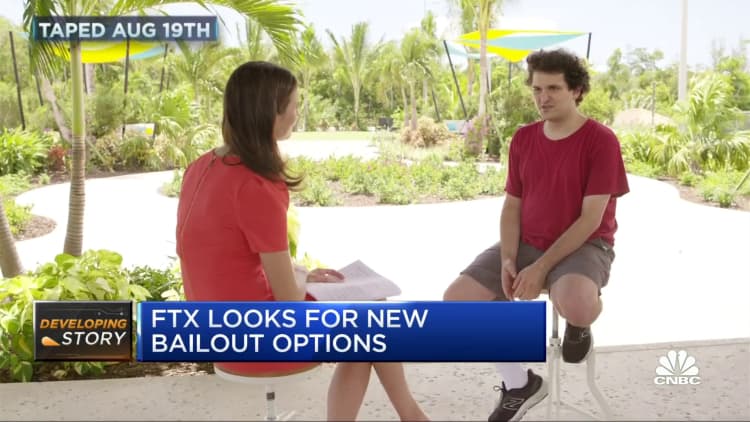
It’s almost as if Bankman-Fried was describing his own fate.
FTX’s lightning-fast descent began this past weekend after Binance CEO Changpeng Zhao tweeted that his company was selling the last of its FTT tokens, the native currency of FTX. That followed an article on CoinDesk, stating that Alameda Research, Bankman-Fried’s hedge fund, held an outsized amount of FTT on its balance sheet.
Not only did Zhao’s public pronouncement cause a plunge in the value of FTT, it led FTX customers to hit the exits. Bankman-Fried said in a tweet Thursday that FTX clients on Sunday demanded roughly $5 billion of withdrawals, which he called “the most important by an enormous margin.” Lacking the reserves to cover the virtual bank run, FTX turned to Zhao for help.
The way it’s going
Binance announced a nonbinding agreement to accumulate FTX on Tuesday, in a deal that might’ve been so catastrophic for FTX that equity investors were expecting to be worn out. But Binance reversed course a day later, saying that FTX’s “issues are beyond our control or ability to assist.”
Bankman-Fried scrambled to give you billions of dollars, but on Friday the corporate filed for Chapter 11 bankruptcy within the U.S. Within the filing, FTX indicated it has assets within the range of $10 billion to $50 billion and liabilities in the identical range.
Enterprise firm Sequoia Capital, which first backed FTX in 2021 at an $18 billion valuation, said it was marking its $213.5 million investment in FTX “all the way down to 0.” Multicoin Capital, a crypto investment firm, told limited partners on Tuesday that while it was in a position to retrieve about one-quarter of its assets from FTX, the funds still stranded there represented 15.6% of the fund’s assets, and there is not any guarantee it should all be recouped.
Moreover, Multicoin said it’s taking a success because its largest position is in solana, which was tumbling in value since it “was generally considered to be inside SBF’s sphere of influence.” The firm said it’s sticking to its thesis and in search of assets that may “outperform market beta across market cycles.”
“We usually are not short term or momentum traders, and we don’t operate on short time horizons,” Multicoin said. “Although this case is painful, we’re going to remain focused on our strategy.”
It won’t be easy.
Ryan Gilbert, founding father of fintech enterprise firm Launchpad Capital, said the crypto world is facing a crisis of confidence after the FTX implosion. While it was already a tumultuous 12 months for crypto, Gilbert said Bankman-Friedman was a trusted leader who was comfortable representing the industry on Capitol Hill.
In a market and not using a central bank, an insurer or any institutional protections, trust is paramount.
“It’s a matter of, can trust exist in any respect on this industry at this stage of the sport?” Gilbert said in an interview Thursday. “To a big extent the concept of trust is as bankrupt as a few of these firms.”
WATCH: Crypto exchanges are scrambling