


This week, Joe Biden is anticipated to sign into law the most important ever U.S. commitment to fighting climate change. In consequence, it’s estimated that, by 2030, our carbon emissions will fall greater than 40 percent compared with 2005 levels—putting the nation nearly on the right track to achieve Paris Climate Accord targets.
Frankly, that is stunning. Lots of us, especially young people, have been conditioned to imagine that something like this could never occur. We believed that any climate bill would die on the feet of Joe Manchin, that our legislators were hopeless septuagenarians who simply didn’t care enough, and that life as we realize it would come to a grinding halt in our lifetime. I do know so lots of my peers who simply gave up hope for a moment like this.
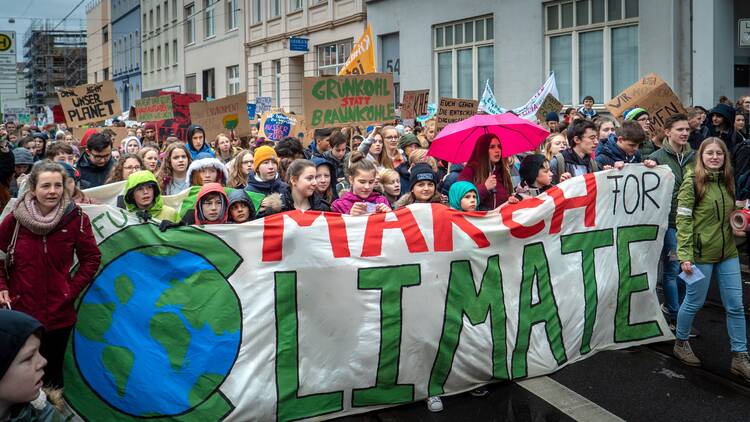
I don’t think older Americans fully understand how prevalent and the way devastating that feeling is. Many in my generation have grown up with such a thoroughly paralyzing fear of climate catastrophe that psychologists have even coined a term for it—“eco-anxiety.”
This level of angst and nihilism will not be normal.
One team of researchers, including Stanford Professor Britt Wray, tried to quantify “eco-anxiety” amongst young people in 2021 by surveying 10,000 of them across 10 countries. The outcomes? Seventy-five percent said that the long run was “frightening.” Fifty-six percent said they’d experienced the sensation that “humanity is doomed.” Most strikingly, around 40 percent were “hesitant” to have children resulting from climate concerns.
This level of angst and nihilism will not be normal, and it’s been beaten into a complete generation by watching setback after setback for major climate laws. It’s out of sync with reality, though. The climate crisis is a solvable problem, and the international community has successfully tackled environmental issues before. Keep in mind that time when the ozone layer was shrinking? Most young people don’t—and that’s because in 1987, we passed the Montreal Protocol and banned the chlorofluorocarbons liable for ozone layer depletion. Now, our ozone is recovering and can be healed by 2060.
That will not be the one success story. Within the late twentieth century, environmental scientists and activists loudly rang the alarm bell about acid rain. In response, after a drawn-out legislative fight spanning multiple many years, Congress passed the Clean Air Act, which included specific measures to combat the crisis. Sulfur dioxide emissions have since fallen precipitously, as have key indicators of acid rain across the USA.
Looking back on the long history of successful climate efforts might teach us something concerning the path that lies ahead, and more importantly, the right way to overcome climate denial. I feel, nevertheless, that we’re stuck with an old-fashioned view of what that denial actually looks like.
Then comes the ultimate stage of climate denial: “Humans caused climate change. It is going to be terrible and we could have stopped it, but we’re out of time. We’re doomed.”
As many have identified, climate denial is available in stages. The primary stage is “climate change doesn’t exist.” Then, it’s “climate change exists, but humans didn’t cause it.” By that time, we get to “O.K., humans caused climate change, but it surely won’t be that bad.” When you cross that hurdle, you arrive at “climate change can be bad, but there’s nothing we are able to do about it.” Then comes the ultimate stage of climate denial: “Humans caused climate change. It is going to be terrible and we could have stopped it, but we’re out of time. We’re doomed.”
That sort of considering is dangerous. We aren’t out of time and the cause isn’t doomed. If this week has shown us anything, it’s that meaningful climate motion is feasible, and all available evidence leads us to imagine that our actions could have a considerable impact on the climate crisis. There’s reason to hope.
There’s something deeply Christian about that realization. The Jewish and Christian traditions, in spite of everything, have an extended history of political and spiritual optimism that dates all the best way back to Israel’s slavery in Egypt and runs through the Babylonian captivity and to the Book of Revelation’s empathic defiance of the Roman Empire (“Fallen, fallen is Babylon the good!”). The story of the Jewish people, and of the Christian faithful, is a story of defiant hope against all odds.
As a matter of religion, Christians must live in hope for themselves, for one another and for God’s salvific power. It will not be optional.
That hope is vital on a private level, too. I’m reminded of Judas. The apostle is known for his betrayal of Jesus, but I’ve at all times been most struck by what happens afterward: He realizes just how mistaken he was and loses hope. Judas involves imagine that his own sin was greater than God’s infinite goodness. Thomas Aquinas identified this “despair” as a type of “blasphemy against the Holy Spirit,” the famously “unforgivable sin.”
It will be mistaken (despairing, even) of us to presume that anyone is closed off to divine forgiveness. Yet Thomas communicates something else here—that to be a Christian is to live in hope, and to present up hope is to present up every little thing.
As a matter of religion, Christians must live in hope for themselves, for one another and for God’s salvific power. It will not be optional.
Can we feature forward a few of that energy to our political lives, even within the face of a climate crisis? Can my generation rediscover the virtue of hope—not only in God, but in one another?
I sure hope so.