


Editor’s note: This text is an element of The Conversation with America Media, offering diverse perspectives on necessary and contested issues within the lifetime of the church. Read other views on the traditional Latin Mass, in addition to news coverage of the subject, here.
Pope Francis’ restrictions on the Latin Mass, made one yr ago through the motu proprio “Traditiones Custodes,” struck some Catholics as an unwelcome intervention in a treasured tradition. But some observers, even when not Latin Mass attendees themselves, offered an answer: Why not bring elements of the Latin Mass to the Peculiar Type of the Mass that got here into use after the Second Vatican Council, practicing the mutual enrichment Pope Benedict XVI advocated within the motu proprio “Summorum Pontificum” in 2007?
Why not bring elements of the Latin Mass to the Peculiar Type of the Mass that got here into use after the Second Vatican Council?
Unfortunately, “Traditiones Custodes” may lead dioceses to do the alternative and be overly restrictive of elements of the Latin Mass, thereby alienating Catholics who attend the Peculiar Type of the Mass but are interested in many liturgical elements of the Latin Mass.
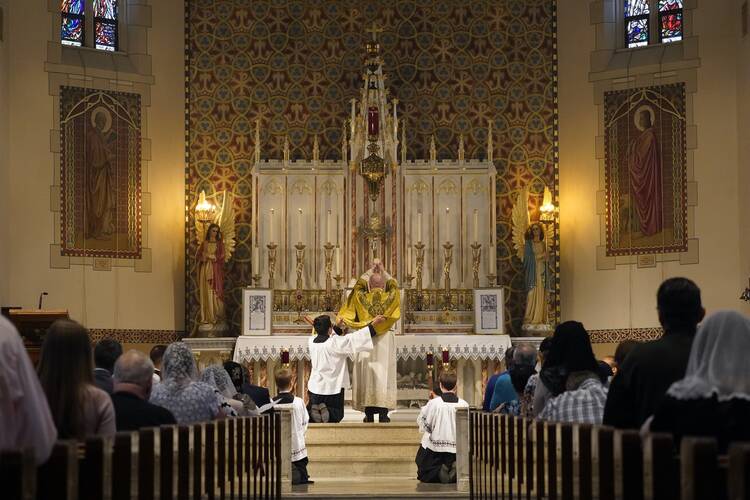
It is feasible to have a Mass within the Peculiar Form celebrated ad orientem—using the liturgical posture where the priest and the congregation face the altar as one for many of Mass—with Gregorian chant, incense, and receiving Holy Communion on the tongue while kneeling if the communicant so desires. The Mass may even be celebrated entirely in Latin, so long as it follows the present Roman Missal.
How about an easy solution to the liturgy wars?
Latin Novus Ordo. Gregorian chant, bells, incense.
All the benefits of the Tridentine Mass (beauty, reverence) without its disadvantages (excessive hierarchy, crimped lectionary).
Would this be enough to attain a truce?
— Tony Annett (@tonyannett) January 5, 2022
I even have found that these postures, chants and more have helped place my deal with the sacrifice happening on the altar and allowed me to enter right into a more spiritual participation, even in a Mass where the readings and lots of prayers are in my very own language. That is mutual enrichment done well.
As Pope Benedict XVI wrote in his letter to bishops that accompanied “Summorum Pontificum,” a mutual enrichment of the 2 types of the Roman Rite would signify “the sacrality which attracts many individuals to the previous usage.” That’s, the surest way for Catholics to acknowledge beauty within the Peculiar Form is by celebrating it in fidelity with the rubrics and retaining reverential postures that focus one’s attention on the sacrifice at hand.
Remember, some observers could also be quick to say, “Traditiones” is just not an attack on the liturgical tradition itself. Pope Francis wrote in his letter to bishops that “whoever wishes to have fun with devotion based on earlier types of the liturgy can find within the reformed Roman Missal based on Vatican Council II all the weather of the Roman Rite.” Celebrating the Mass based on the Roman Missal can definitely include liturgical elements resembling the priest facing the altar.
Liturgical elements resembling kneeling for Communion face extreme scrutiny for the sake of reining within the celebration of the Latin Mass.
But there may be a temptation to say otherwise within the name of “ecclesial communion.” In dioceses in the USA and world wide, liturgical elements resembling celebrating Mass ad orientem, kneeling for Communion and any use of Latin face extreme scrutiny for the sake of reining within the celebration of the Latin Mass.
Not only did the Costa Rican bishops’ conference issue an entire ban on the Latin Mass throughout all the country following “Traditiones Custodes,” it also prohibited the prayers, vestments and rites prior to 1962 from the celebration of the Peculiar Form. Even so, it was a surprise when the Catholic News Agency reported that a priest was being suspended and sent for psychological treatment for celebrating the Peculiar Form in Latin and ad orientem, neither of which was mentioned within the bishops’ statement.
In the USA, the Archdiocese of Chicago has restricted the ad orientem posture, announcing that “Mass can be ordinarily to be celebrated ‘versus populum,’ unless permission is granted otherwise by the archbishop.” Within the statement released to the archdiocesan newspaper, Chicago Catholic, the necessity for “a concrete manifestation” of the acceptance of Vatican II was given as an evidence for the rule. Some Catholic web sites which have often been critical of “Traditiones Custodes” have been sharing claims of comparable restrictions in other U.S. dioceses.
No such restrictions were called for by Pope Francis in “Traditiones Custodes.” When he wrote about “eccentricities that may easily degenerate into abuses,” he was clearly referring to questionable celebrations of the liturgy within the wake of Vatican II that will have driven people to hunt parishes—Latin Mass or not—that remember Mass with, to borrow Francis’ phrase, “decorum and fidelity.”
It is feasible to have a Mass within the Peculiar Form celebrated ad orientem—using the liturgical posture where the priest and the congregation face the altar as one for many of Mass.
As a substitute of promoting unity, excessive restrictions on elements of the Latin Mass would do three things. First, they’d undermine the expressed intention and letter of Pope Francis’ motu proprio, thereby seeming to vindicate his critics. Second, they’d further push away Latin Massgoers to their very own separate parishes. Third, they’d alienate Catholics who desire the reformed liturgy but in addition seek the wealthy liturgical elements of the centuries-old Tridentine celebration.
It is a personal issue for me. I used to be married last July, and my wife and I knew that our wedding liturgy within the Peculiar Form was a possibility to evangelize to the fallen-away Catholics and non-Catholics in attendance. There was absolute confidence that it will be celebrated ad orientem, with all facing our Lord on the altar and within the tabernacle. We chosen classic hymns resembling “O God Beyond All Praising” and “Love Divine, All Loves Excelling” while chanting the Missa de Angelis for the common Mass parts. The readings and other Mass parts were in English. Kneelers were placed so one could kneel for Communion in that case desired.
We received many comments afterward from individuals who had not witnessed these liturgical elements in many years but felt the transcendent effect of them in the brand new Mass. It remained familiar to them, yet otherworldly. Shouldn’t that be what experiencing heaven touching earth must be like?
The church’s liturgical tradition is our inheritance as Roman Catholics. Catholics like me are uninterested in being dragged into the so-called liturgy wars just because we discovered and desire to enact our liturgical inheritance. Restricting or abolishing such elements wouldn’t seem so as to add up with the letter and spirit of liturgical law and wouldn’t be consistent with this time of synodal listening for the church.