


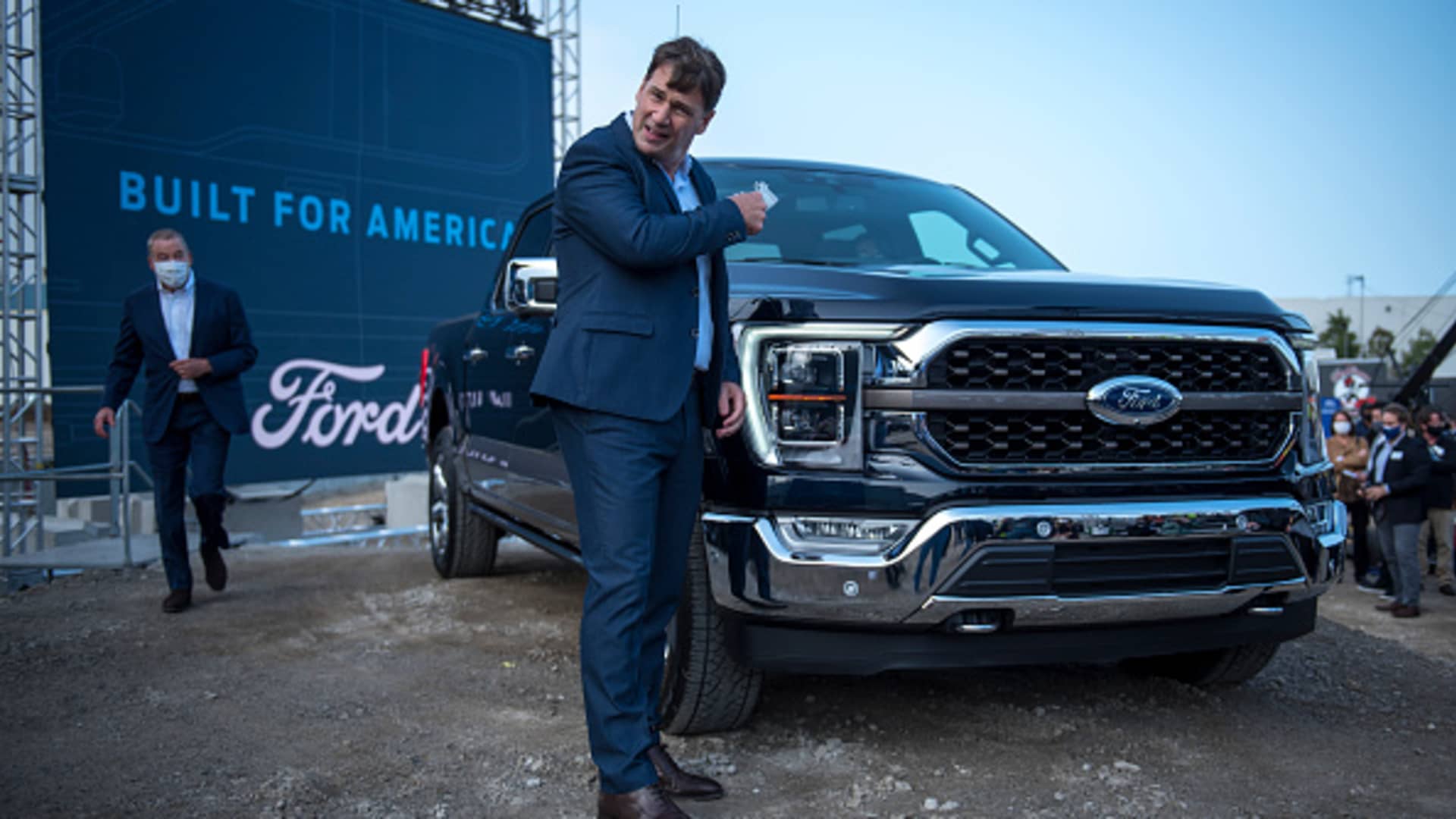
Ford CEO Jim Farley takes off his mask on the Ford Built for America event at Fords Dearborn Truck Plant on September 17, 2020 in Dearborn, Michigan.
Nic Antaya | Getty Images
DETROIT – Ford Motor reported an unpleasant fourth quarter, missing Wall Street’s earnings expectations and falling wanting its own full-year guidance by $1.1 billion, as the corporate reported “execution issues” that plagued operations.
Ford’s fourth-quarter net income was $1.3 billion, $11 billion lower than the identical period a 12 months earlier. For the total 12 months, Ford lost $2 billion, nearly $20 billion off its 2021 profit.
“We should always have done a lot better last 12 months,” CEO Jim Farley said in an earnings release. “We left about $2 billion in profits on the table that were inside our control, and we will correct that with improved execution and performance.”
Shares of Ford were off by greater than 6% during afterhours trading. The stock closed Thursday at $14.32 per share, up 3.8% on the session.
Here’s how Ford performed within the fourth quarter, compared with analysts’ estimates as compiled by Refinitiv:
- Adjusted earnings per share: 51 cents vs. 62 cents estimated
- Automotive revenue: $41.8 billion vs. $40.37 billion estimated
The corporate’s overall revenue increased 16% to $158.1 billion for 2022, including a 17% uptick within the fourth quarter to $44 billion.
In October, Ford said it expected full-year adjusted earnings before interest and taxes of between $11.5 billion and $12.5 billion. On Thursday it reported 2022 earnings of $10.4 billion, nearly flat 12 months over 12 months.
“‘I’m frustrated’ is an understatement, since the 12 months might have been so far more for us at Ford,” Farley told investors during an earnings call.
Ford CFO John Lawler said Thursday that the corporate’s disappointing earnings were largely on account of execution and provide chain management issues. The corporate fell wanting expected sales by 100,000 units, equating to about $1 billion in missed earnings, he said.
Lawler said the automaker is trying to cut additional costs this 12 months. He didn’t rule out additional layoffs, specifically in Europe. He said the opposite $1 billion in missed opportunities last 12 months were related to costs.
“Our cost structure isn’t competitive,” he said during a media call. “Our quality isn’t where it must be. And we’ll take the actions and be more aggressive about ensuring that we’re making progress on each of those key areas for us in 2023.”
“It’s a major amount we plan on taking out this 12 months,” Lawler said regarding cost-cutting, adding more information will come all year long.
Ford also shall be providing more clarity on its traditional business operations, electric vehicles and Ford Pro fleet business units — the automaker said it is going to begin reporting each business unit individually this 12 months.
Lawler said Thursday that Ford’s EV business isn’t currently profitable. The corporate earlier this week cut costs of its top-selling electric Mustang Mach-E crossover in response to Tesla EV price cuts.
Executives said Ford hoped to offset a number of the profit shrink with cost improvements because of the extra production in addition to a discount in some commodity costs.
There was pressure on Ford to deliver a powerful fourth quarter and comparatively solid guidance. Crosstown rival General Motors on Tuesday significantly outperformed Wall Street’s expectations. That automaker also forecast stronger-than-expected 2023 results, including adjusted earnings before interest and taxes of $10.5 billion to $12.5 billion and adjusted earnings per share of between $6 and $7.
For 2023, Ford said it expects to earn between $9 billion and $11 billion in adjusted earnings before interest and taxes, presuming seasonally adjusted annual rates of about 15 million vehicles within the U.S. and about 13 million in Europe.
Ford anticipates generating about $6 billion in adjusted free money flow. That assumes “no distributions” from its financial arm Ford Credit, the corporate said.
“We’re executing a double transformation. While we’re making progress, it’s labor,” Farley told investors. “As with all transformation of this magnitude, certain parts are moving faster than I expected and other parts are taking longer.”