


Whenever the U.S. and Iran, two geopolitical rivals who severed formal diplomatic ties in April 1980, meet in any form of international sporting competition, it’s greater than a game. The Group B World Cup match going down between the 2 nations in Doha on Nov. 29 is removed from an exception.
Mass protests have erupted across Iran since 22-year-old Mahsa Amini died on Sept. 16 while in police custody after she allegedly violated the country’s mandatory hijab laws. Not less than 445 demonstrators have been killed for the reason that protests began, including 63 children, in response to the Tehran-based Human Rights Activists News Agency. Meanwhile, Iran’s World Cup soccer players refused to sing the national anthem, in solidarity with the protestors, before the team’s opening game against England on Nov. 21. (Iran lost that game, 6-2. The players mouthed along to the anthem before the team’s dramatic 2-0 victory over Wales on Nov. 25, days after former national player Voria Ghafouri was arrested for “spreading propaganda;” Ghafouri is a longtime critic of the regime.)
Read More: Team USA’s World Cup Fate Is in Their Own Hands Following Tie With England
Briefly, the stakes couldn’t be higher. And we haven’t even mentioned the soccer part. After Iran’s victory over Wales and America’s 0-0 draw against England on Black Friday, the U.S. must beat Iran to advance to the knockout stage. With an Iran victory; Iran advances. A draw would put Iran within the Round of 16, if England beats or draws with Wales. For the U.S., failing to make it to the Round of 16 can be one other crushing World Cup disappointment, a setback that would quell the team’s momentum going into the 2026 tournament, which it can host together with Mexico and Canada.
It’s simply win or go home.
Iran is in search of a repeat
This marks the second World Cup meeting between the U.S. and Iran. The primary, back in 1998 in France, unfolded under very different circumstances. The 1979-80 hostage crisis, by which Iranian students held greater than 50 U.S. diplomats and residents hostage for greater than a 12 months, was less of a distant memory. That followed the 1979 revolution that forced longtime U.S. ally and autocrat Mohammad Reza Shah, the last Shah of Iran, into exile: Ayatollah Khomeini got here into power declaring Iran an “Islamic Republic.” Intense opposition to the U.S. was a core—and popular—tenet of Khomeini’s theocracy due to historical grievances. That features the 1953 CIA-backed coup of Iran’s last democratic leader, support for the unpopular Shah in subsequent years, and backing Saddam Hussein’s 1980 invasion of Iran—a war that lasted eight years and left no less than an estimated 500,000 dead.
Still, there are some lessons from that first meeting which can be useful for today, especially for the Americans. Most pointedly: attempt to harness the longstanding geopolitical rivalry at play. (Those tensions proceed to run high: on Wednesday, Washington levied economic sanctions on three Iranian security officials attributable to the regime’s crackdown on protests.)
Back in 1998, Team USA went out of its technique to downplay the political rivalry with Iran and embraced the strategy of just specializing in the sport. Iran then beat the U.S. 2-1 in Lyon, eliminating it from the tournament. The loss was a low-point for American soccer, which seemed on the upswing after the U.S. hosted a successful 1994 World Cup.
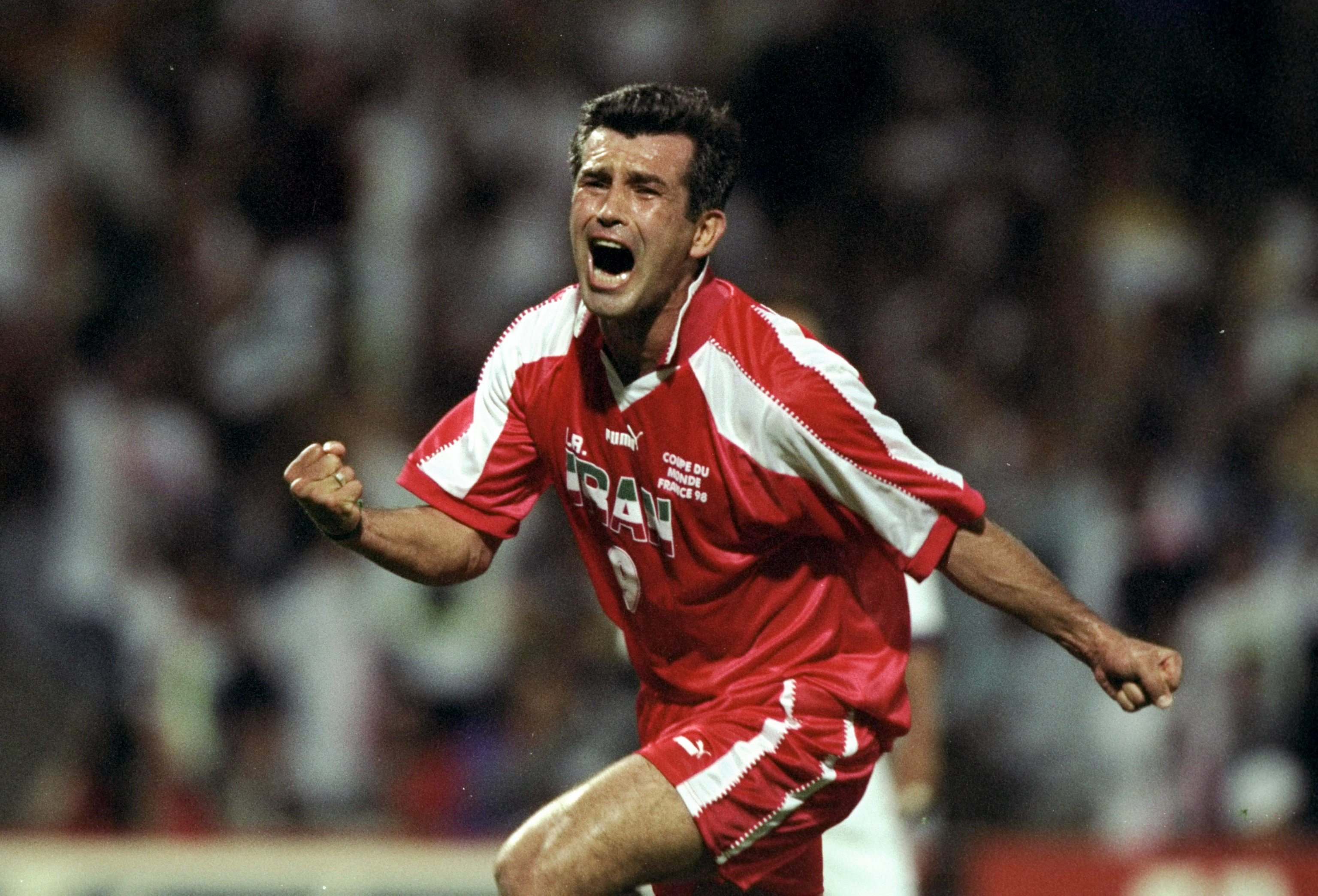
Hamid Estili of Iran in motion throughout the World Cup first round match against the USA on the Stade Gerland in Lyon, France in 1998. Iran won the match 2-1.
Ben Radford/Allsport—Getty Images
All about politics
Zooming in from Qatar a number of hours before analyzing the France-Australia Group stage game for a Spanish-language broadcaster, Steve Sampson, the U.S. coach back in 1998, says he’s spent a number of time over the past 24 years desirous about what he would have done in a different way going into that Iran game. “We were asked by FIFA, by U.S. Soccer, by the organizing committee in France, to make it about football, and never about politics. And I went together with that,” says Sampson. “In hindsight, I’d have made it about politics. A coach’s job is to make use of any and each tool available to him to organize his team.”
Sampson notes he was a young coach—41 then—who was inclined to fall in step with institutional wishes fairly than go rogue. He resigned after the World Cup, after a 0-3 showing by which the U.S. finished last amongst 32 teams. If Sampson could do it again, he says, he would have leaned into the geopolitical rivalry—just because the Iranians did. “So many Americans have been hurt so dramatically by the Iranian regime,” says Sampson. “We could have played for them.”
Read More: Weary and Thirsty, World Cup Fans Attempt to Find Joy at a Complicated Tournament
Strategic differences aside, tensions were running high in the times prior to the sport. Per week prior to the Jun. 21, 1998 kick-off, French television aired an American movie, Not Without My Daughter, which depicted the cruel conditions of life in Iran. The Iranian embassy announced that “Iran is considering removing its national team from the World Cup in protest against the published of the anti-Iranian film.” Iran’s Supreme Leader Ayatollah Ali Khamenei also threatened to tug Iranian players because he didn’t want them shaking American hands, as FIFA procedure dictated. However the referee, Urs Meier from Switzerland, proposed a wise solution. The players as a substitute posed for a bunch picture at center-field. The Iranians gave the American athletes white roses, an emblem of peace, and each teams exchanged banners.
By the point of kick-off, though, security was ramped up “10-fold,” in response to Sampson. A FIFA official said there have been 150 armed cops—”unprecedented for a World Cup match”—on duty. (The improved presence was there, partially, due to fears that members of Iranian political opposition group, Mojahedin Khalq, would disrupt the match.)
Iran took a more hawkish approach to the match-up. Based on a November article within the journal Middle Eastern Studies, Iranian defender Mohammad Khakpour said that many families of war victims from the 1980-1988 Iran-Iraq conflict reached out to the athletes—detailing at length how significant the match was for them, and begging them to defeat the U.S. “Many families of martyrs expect us to win,” forward Khodadad Azizi said before the sport.
Meanwhile, Iranian media hammered the U.S. in pre-game coverage. One two-part editorial, for instance, within the hardline newspaper Jomhuri-ye Eslami, drummed up national fervor. The piece was headlined “The US Is Still the Iranian Nation’s Enemy Number One.”
Throughout the match itself, a number of early U.S. shots hit the post. Within the fortieth minute, a gorgeous Hamid Estili header gave Iran a 1-0 lead. “It became very, very clear that for Iran, that was far more than a soccer game,” says Fox Sports commentator Alexi Lalas, a defender on the 1998 U.S. team. “They harnessed that in a way that we didn’t.”
Sampson says that his Iran’s coach on the 1998 World Cup, Jalal Talebi, later shared with him that at half-time, Iranian government officials got here into the locker room and picked up the passports of the players. Based on Sampson, Talebi said that officials told the players that “in the event that they didn’t beat the US, they weren’t welcome back into Iran, nor were their families welcome to go away Iran.” (Talebi couldn’t be reached for comment; an Iranian soccer official in Qatar didn’t return TIME’s request for comment.)
Iran essentially put the sport away with a goal within the 84th minute. A Brian McBride goal within the 87th minute gave the U.S. one last hope, nevertheless it was too late.
After the ultimate whistle, the U.S. team did not hide its devastation. Sampson and a few players cried. “It was a whole fiasco and failure and embarrassment,” says Lalas, who didn’t play your entire tournament.
The Recent York Times reported after Iran’s win that “in Teheran, 1000’s of celebrating fans took to the streets, some women without their scarves.” Supreme Leader Ayatollah Ali Khamenei was exultant. “This unique struggle is what has given victory and glory to our nation in the midst of the revolution, throughout the years of holy defense, and in all the Iranian nation’s conflicts with the Great Devil,” he said after the sport.
On the road
Going into this final Group stage game against Iran on Tuesday, it will be difficult for the American players to view their Iranian counterparts as political enemies. In spite of everything, they’ve signaled opposition to Iran’s repressive regime. Yehuda Blanga, a professor at Israel’s Bar-llan University who co-wrote the Middle Eastern Studies article, says that while most Iranian players supported their government in 1998, that’s not the case this time around.
Sampson advises his coaching counterpart all these years later, Gregg Berhalter, to acknowledge each this historical rivalry and the protest movement occurring in Iran. But at the identical time, he says Berhalter can’t show an excessive amount of deference to the opposition. “Don’t buy into the sympathy piece,” says Sampson. “It’s real, and we appreciate that. Just deal with coming fully prepared to do the business on the sphere.”
In other words, the U.S. can take a cue from England, a team that has put progressive values front and center but dominated Iran on the pitch. If the past is any guide, football diplomacy might only end in tears in a losing World Cup locker room, wondering what might have been.
More Must-Reads From TIME