



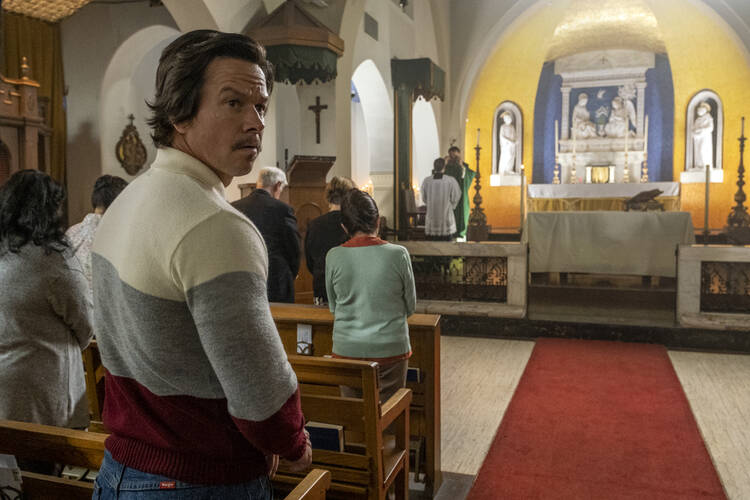
“Father Stu” is sort of a work of conceptual art—it represents an idea. You don’t at all times have to see it to get the gist. And sometimes it’s just as well you don’t.
The biographical film, “based on a real story” (a phrase intended to offer wiggle room) stars Mark Wahlberg as Stuart Long, an amateur boxer turned Catholic priest who at the start of his clerical profession was stricken with a disabling and ultimately fatal neurological disease. The movie’s message is redemption, in fact, something implicit within the casting of the film: Mark Wahlberg has had his share of public problems. As well as, Mel Gibson, who carries more baggage than Delta Airlines, plays Stu’s father, Bill, whom one is tempted to explain as irredeemable—except in fact, that will imply the message of the movie wasn’t getting across.
“Father Stu” is meant to be inspirational, but viewers may find any sense of elevation elusive.
Written and directed by Gibson’s partner (and mother of his child), Rosalind Ross, “Father Stu” is meant to be inspirational, but viewers may find any sense of elevation elusive. Stu pursues his fighting “profession,” corresponding to it’s, far beyond an affordable age or state of health (early on, a health care provider advises him to quit and receives a torrent of vulgarity in return). He’s a dogged form of guy who will approach his religious calling—he receives a visit from the Blessed Virgin after a near-fatal motorcycle accident—with the identical unreasonable expectations he delivered to boxing. Malcolm McDowell, who plays the seminary rector, Monsignor Kelly, who receives Stu’s application for enrollment, is actually a sympathetic character, sympathetically portrayed: Stu might be essentially the most improbable candidate Kelly has ever considered, never mind essentially the most abrasive. However the spirit of “Father Stu” is “never quit.” Stu doesn’t; Kelly does.
Long was a priest for less than 4 years before succumbing at age 50 to his degenerative muscle disease (inclusion body myositis), so “Father Stu” by necessity spends the primary of its two hours on Stu’s pre-vocational life, an aimless journey that involves small-time criminality, drunkenness, a mutually abusive relationship together with his father and, after boxing, a journey west where he hopes to get into acting. The portrayal of Hollywood is calculated to feed conventional biases: The primary casting agent Stu meets, a person, makes a sexual overture to him and is, in fact, assaulted for his trouble.
Stu approaches his religious calling with the identical unreasonable expectations he delivered to boxing.
“You don’t belong with those people,” advises his mom, Kathleen (Jacki Weaver, burdened with dialogue only a scriptwriter’s mother could love). Stu doesn’t listen. Stu never listens. (Except to Mary.) What audiences will likely be wondering about is Stu’s self-regard: Does he really think he’s charming? As portrayed by Wahlberg, he’s the other—vulgar, obnoxious, too old for juvenile delinquency and burdened with a myopia about social signaling and appropriate behavior that seems intended to be heroic yet is anything but. It’s a very cringeworthy experience watching Stu’s courtship, because it were, of Carmen (Teresa Ruiz), the attractive young member of a neighborhood church who’s clearly too devout for Stu. (“As Catholic because the cross,” someone says of her.) As a part of his campaign to woo Carmen, Stu offers to be baptized. “Imperfect contrition” would describe his first confession, though that will even be putting it mildly.
Carmen is eventually won over, which can mystify viewers. So may Stu’s decision to hitch the priesthood (and leave Carmen behind) after surviving his bike crash and receiving visits from Jesus in a bar and Mary on the roadside. “She don’t give a great goddamn a few real mother’s son,” Kathleen wails, as if she would have preferred Stu to perish. His father’s response is equally supportive: Stu’s try and join priesthood “is like Hitler trying to hitch the ADL.” It might be funny, in the event you weren’t immediately struck by the notion that Bill would do not know what the ADL is. And that Mel Gibson undoubtedly does.


