



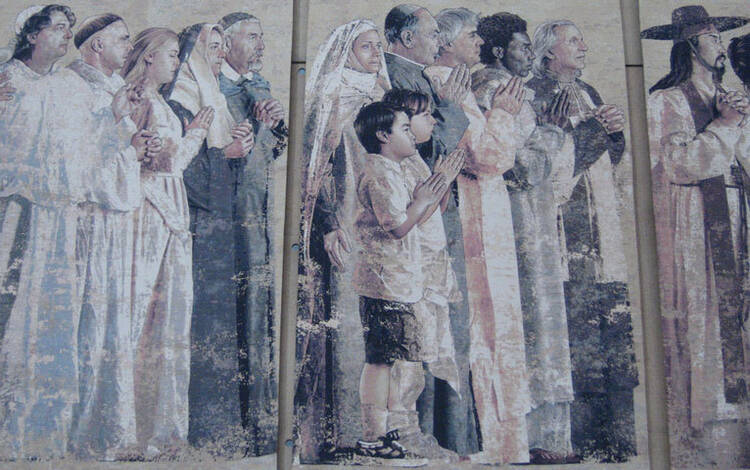
Blissful All Saints Day! While tomorrow, All Souls Day, is a little more inclusive so far as memorials go, today’s feast can also be a very important one for anyone searching for to live a lifetime of holiness—it turns our eyes toward the examples of sanctity in our contemporary milieus and within the history of the church. And we’ve all known a saint or two in our own lives, haven’t we? Even when not, the church gives us many examples of such, from apostles to martyrs to doctors to some real characters who may need seemed unlikely candidates once upon a time. There’s even a patron saint of writers, St. Francis de Book Sales.
Saints are “concurrently exceptional and extraordinary: ideals of holiness that awe us, encourage us toward deeper piety and convict us in our moral finitude.”
Over the a long time, America has all the time had time and space not just for this feast but for the cult of the saints basically. Our inaugural issue on April 17, 1909, featured a review of three books on St. Joan of Arc, including Mark Twain’s Personal Recollections of Joan of Arc. (The reviewer, Michael Kenny, S.J., insisted on calling him Samuel Clemens.) In more moderen times, America editor at large James Martin, S.J., turned a 2005 reflection(“The Saint of the Sock Drawer”) into the place to begin for The Recent York Times best-seller, My Life With The Saints.
Just previously two weeks, America ran two stories on Peter Gumpel, S.J., who spent a long time in Rome working on the causes of assorted candidates for sainthood: Kenneth L. Woodward’s “The ultimate secret of the Vatican’s Jesuit saint maker” and Colleen Dulle and Gerard O’Connell’s “Contained in the Vatican” podcast. Woodward’s 1990 book Making Saints: How The Catholic Church Determines Who Becomes A Saint, Who Doesn’t, And Why introduced many readers to the exhaustive and sometimes byzantine processes by which candidates for sainthood are recommend and promoted. In 2019, Kathleen Sprows Cummings showed in A Saint of Our Own how the causes of saints can sometimes be certain up with national and ethnic self-understandings.
In his review of the latter for America, Jack Downey noted that saints may be many things directly. They’re “concurrently exceptional and extraordinary: ideals of holiness that awe us, encourage us toward deeper piety and convict us in our moral finitude. Also they are thaumaturgical protectors who miraculously cure us of terminal illnesses, keep our family members protected during times of war and help us find stuff.” But at the identical time, they “are also essentially mascots of particular causes, places and nations. And as such, also they are subject to ecclesiastical politics.”
In 2003, Lawrence Cunningham reviewed Robert Ellsberg’s The Saints’ Guide to Happiness for America, noting that Ellsberg had not turned to the saints to seek out “a smiley-face existence, and even Aristotle’s fullness of life derived from an intellectually and morally ordered way of being.” Slightly, Cunningham wrote, “he has in mind that happiness rooted within the Beatitudes of Jesus, whose introductory word is more commonly translated today as blessed, reasonably than pleased.”
In fact, as Cunningham notes, “the happiness promised within the Beatitudes often has an oxymoronic character in that, alongside peace and mercy, its litany of blessings includes words not normally related to happiness—corresponding to mourning and poverty.” Holiness, in other words, is not any laughing matter. Nor, Ellsberg argues, is it “a code of conduct or a program to be followed, but a certain habit of being, a certain fullness of life.” Nonetheless, Ellsberg also cites his mentor (and sure saint) Dorothy Day in arguing that happiness and holiness go together: “halfway to heaven is heaven.”
In 2014, Holly J. Grieco reviewed Robert Bartlett’s Why Can the Dead Do Such Great Things? for America. Bartlett stresses through myriad examples, Grieco notes, that “the interactions between the saints, living and dead, and the faithful” throughout much of Western Christian history have been dynamic ones: The faithful have attributed to their saints intercessions and grace-filled interventions; meanwhile, the saints (especially of their burial places) were venerated by the faithful who saw their presence as an integral element of their lives.
There’s even a patron saint of writers, St. Francis de Book Sales.
For this reason dynamic (a kind of sensus fidelium in miniature), many saints throughout history gained their status not through official proclamations, but through popular acclaim. Grieco notes that though Twelfth- and Thirteenth-century popes reserved for themselves the authority to declare someone a saint, still “within the later Middle Ages a whole bunch of men and ladies were still recognized as saints by public acclamation.”
It is a phenomenon we frequently associate with ancient legends (does St. Christopher still make the cut? St. Ursula? St. George and his dragon?), where there’s little historical evidence for the existence of the person in query, but public acclamation continues to be a really real thing today. I used to be blessed to be present for each the 2015 beatification (in San Salvador) and the 2018 canonization (in Rome) of St. Óscar Romero; at the previous, where Romero was declared “blessed,” there have been flags, posters, prayer cards and t-shirts in all places in San Salvador proleptically declaring him “San Romero.” Why wait for Rome? All of us knew he was a saint.
Any have a look at the calendar of saints will show that it hasn’t all the time been essentially the most inclusive list: There are lots of Europeans, lots of men, lots of priests and bishops and popes and lots of virgins and second-chance celibates, even counting those canonized under our saint-happy last three papacies. That appears to be changing a bit: Pope Francis has mentioned the church’s need for more women saints, and in 2007, America editor in chief Drew Christiansen, S.J., wrote of the necessity for more diverse models of holiness amongst our saints.
“So after we look to saints and martyrs today as models for ourselves, we must always find not only men and ladies of virtue for us to emulate, but in addition flawed human beings, whose personal struggles to reply to God’s grace of their weakness led to the transformation of their characters,” Christiansen wrote. “For us these men and women are tests of our own willingness to be thoroughly converted. How we’re conformed to Christ in our weakness is the test of holiness for us all.”
Many saints throughout history gained their status not through official proclamations, but through popular acclaim.
•••
Our poetry selection for this week is “Because my hands are small in comparison with God’s,” by Jane Swart. Readers can view all of America’s published poems here.
On this space every week, America features reviews of and literary commentary on one particular author or group of writers (each latest and old; our archives span greater than a century), in addition to poetry and other offerings from America Media. We hope this can give us a likelihood to offer you more in-depth coverage of our literary offerings. It also allows us to alert digital subscribers to a few of our online content that doesn’t make it into our newsletters.
Other Catholic Book Club columns:
Blissful reading!
James T. Keane